
After looking at a lot of underperforming outbound programs, the conclusion is almost always the same: the list is where it broke. Not the pitch. Not the timing. Not the channel.
A prospect list built on the wrong criteria, outdated contacts, or insufficient data depth doesn’t just produce low conversion rates. It undermines the whole pipeline. Reps waste time on companies that were never a fit. SDRs hit dead numbers and bounced emails. Sales leaders look at activity metrics that look healthy but pipeline that refuses to move.
The fix isn’t to work harder. It’s to build smarter lists, powered by verified data and timely buying signals. Salesforce’s State of Sales research found that 73% of B2B buyers actively avoid sellers who send irrelevant outreach, and only around 40% of a seller’s time is actually spent selling. The rest is lost to admin, manual data work, and chasing the wrong accounts.
This guide covers what an ICP-matched prospect list is and how to build one, step by step, using the data attributes, verification standards, and signal layers that separate high-performing lists from expensive noise.
What is an Ideal Customer Profile (ICP)?
An Ideal Customer Profile (ICP) is a detailed description of the type of company (and the contacts within it) that is most likely to buy your product, get value from it quickly, and become a long-term customer.
It goes beyond basic demographics. A well-built ICP defines the firmographic attributes (industry, size, revenue, geography), technographic attributes (tools and platforms in use), behavioral patterns (how they buy, who holds budget authority), and pain points your solution directly addresses. The more specific your ICP, the more precise your list – and the higher your conversion rate downstream.
For a full guide to building and refining your ICP, see What is an Ideal Customer Profile (ICP) and why you need one.
What is an ICP-matched B2B prospect list?
An ICP-matched B2B prospect list is a curated set of companies and contacts that have been filtered and verified against your Ideal Customer Profile – the defined characteristics of the accounts most likely to buy, convert quickly, and deliver the highest lifetime value.
The distinction between a prospect list and a lead list matters. A prospect list targets companies and contacts that match your ICP but haven’t yet engaged with you. A lead list includes people who’ve already shown some form of interest. Prospects require initial outreach; leads are further along the funnel. Both are valuable – but they require different approaches, and conflating them is one of the most common list-building mistakes.
What separates an ICP-matched list from a generic contact export comes down to three things: the depth of the filtering criteria applied, the accuracy of the underlying data, and whether buying signals have been layered on top to indicate timing.
Why most prospect lists underperform
The numbers tell a clear story. Salesforce’s most recent State of Sales research found that only 35% of sales professionals trust the accuracy of their organization’s data, and that sellers spend roughly 60% of their time on non-selling activity – much of it cleaning up after bad lists. A prospect list of 10,000 unverified contacts produces worse results than a list of 2,000 verified, ICP-matched contacts with current data.
The root cause is almost always one of three things, and they compound. The first is a weak ICP definition. Teams stop at industry, company size, and location, and never layer in technographic, growth, or vertical signals. The list ends up full of accounts that look right on paper but aren’t in-market or high-fit. The second is stale data. B2B contact data decays continuously as people change jobs, companies restructure, and email domains change. Without continuous verification, reps over-research the few records they trust and ignore the rest. The third is the missing signal layer. A firmographic filter tells you who fits your ICP; it doesn’t tell you who is ready to buy this quarter. Without buying signals (funding events, hiring activity, leadership changes, technology adoption), every account looks equally cold, and prioritization becomes guesswork.
How to build an ICP-matched B2B prospect list: a complete guide for sales teams?
Step 1: Define your ICP with precision
Before you build a single list, your ICP needs to be specific enough to generate reliable filters. A vague ICP produces a vague list.
Start with the foundational firmographic attributes: industry, sub-industry, company size (by headcount and revenue), geography, and business model (B2B vs B2C, enterprise vs SMB). These narrow your total addressable market to a workable segment.
Most ICP advice is dangerously generic. If there is one filter that does more work than the rest combined for ANZ and APAC teams, it’s local employee count. Most data providers show a single global headcount figure, but for teams prospecting in specific markets, that number is misleading. A company with 10,000 global employees might have only 45 staff in Australia and 30 in Singapore. That’s not an enterprise account in your market. It’s a regional office that refers decisions back to global HQ. Using verified local employee count, instead of global headcount, is one of the fastest ways to eliminate low-fit accounts that look right on paper but won’t convert. For more on why this matters, see Firmable’s guide to why local employee count beats global headcount in B2B sales.
Then layer in next-generation attributes:
- Technographics – what tools, platforms, or software the company uses. A business running Salesforce signals a certain level of sales maturity and budget. A business on a legacy CRM signals a potential displacement opportunity.
- Growth signals – hiring activity, headcount growth rate, recent funding rounds, office openings. Fast-growing companies have expanding budgets and new problems to solve.
- Vertical-specific attributes – regulatory status, compliance requirements, industry certifications, or sector-specific data points that separate high-fit accounts from superficially similar ones. This is especially important in North American markets where horizontal data alone rarely distinguishes the best accounts within a vertical.
A well-defined ICP should be specific enough that you could hand it to a new SDR and they’d know immediately whether a company is a fit – without needing to do additional research.
For a deeper look at building and refining your ICP, see Firmable’s guide to maximizing marketing and sales effectiveness through ideal customer profiling.
Step 2: Build your list using verified, multi-source data
Once your ICP is defined, you need a data platform that can match it against a verified, continuously refreshed database.
The quality of your list is a direct function of the quality of your data source. There are three things to verify before trusting any platform’s output:
Data freshness. How often are records verified and updated? A platform that refreshes quarterly has already introduced significant decay into every record. Real-time or continuous verification is the standard to hold vendors to.
Verification methodology. The most accurate platforms use a hybrid approach – automated checks combined with human verification for high-value contacts. The benchmark to hold any provider to is whether they can demonstrate – not just claim – their verification rates and the date each record was last confirmed.
Market depth. Global database size does not equal regional accuracy. For teams prospecting in Australia, New Zealand, or broader APAC markets, a platform with deep local coverage – including verified mobile numbers, ABN/NZBN matching, and local business registry data – will dramatically outperform a global platform with thin regional coverage. The market is larger than most global tools represent: as an example, the Australian Bureau of Statistics reported 2.73 million actively trading businesses in Australia at 30 June 2025, with 994,178 of them employing staff – the segment most outbound teams want to reach.
How this plays out in practice. ProcurePro, a procurement software platform built for construction, runs outbound as its primary growth motion across Australia. Global data tools couldn’t consistently surface accurate Australian mobile numbers or the long tail of mid-market construction firms that mattered to them. After switching to Firmable, their SDRs gained verified local decision-maker contact data, faster research, and, critically, visibility into the “hidden middle” of smaller construction firms that traditional databases missed entirely. Co-founder and CEO Alastair Blenkin put it this way: “If you are an Australian business that needs B2B contact information, you must be using Firmable. If you don’t, you’re just wasting your time, because you will get better contact information faster than any other data source.” The full story is here: How ProcurePro built a repeatable revenue engine with verified ANZ data.
The North American equivalent: deep vertical data. North America is a different problem. Market depth isn’t the issue; global databases cover the region in detail. The issue is signal among noise. With millions of companies and dozens of horizontal data providers, generic firmographic filters rarely distinguish the best accounts within a vertical. What does is vertical depth: regulatory status, license and accreditation registers, industry-association membership, certifications, and sector-specific operating data. A list of “SaaS companies in Texas, 50 to 500 employees” returns thousands of accounts at equal priority. A list of “HIPAA-covered healthcare SaaS providers with SOC 2 and a recent funding round” returns the accounts your reps should call this week. Firmable’s North America build is designed around exactly that depth: the same posture our APAC customers rely on, applied to the registers and verticals that drive buying decisions in the US and Canada.
Company registers as a data source. One of the most underused inputs for high-quality prospect lists is company register data. Registers go well beyond basic business registration records. They include membership lists of industry associations, sector-specific licensing databases, accreditation registers, and institutional datasets – all of which give you pre-defined, high-intent segments that generic database searches can’t replicate. For example, pulling members of a fintech association in Singapore gives you a far more precise, verified segment than filtering by “fintech companies in Singapore.” The same logic applies to registered childcare providers in Australia, licensed transport operators, or members of a professional body. These segments are already defined and verified – your list starts clean. Firmable aggregates 140+ company and people registers across APAC, making it possible to build ICP-matched lists from these curated sources directly. For more on how register data powers better prospecting, see the guide to using company registers for B2B sales data.
Firmable’s B2B database is assembled from 140+ verified data sources, continuously refreshed, and covers 3 million+ company records and 25 million+ people records across APAC markets alone – with data attributes that global providers simply don’t have for the region.
Step 3: Layer in buying signals to prioritize outreach
A list filtered to your ICP is a starting point. A list filtered to your ICP and prioritized by buying signals is where the conversion rate difference becomes significant.
This matters more now than it used to. Gartner’s research on the B2B buying journey finds that a typical buying group involves six to ten decision-makers, each independently gathering four to five pieces of information before bringing it back to the group. Reaching one stakeholder cold is rarely enough – but reaching a buying group while they’re already in motion, triggered by a real event, dramatically improves the odds.
Buying signals are real-time data points that indicate a company is more likely to be in an active buying cycle right now. The most valuable signals for prospect list prioritization include:
- Funding events – a new round means fresh capital and new priorities. Outreach within 72 hours of a funding announcement significantly outperforms cold outreach to the same account a month later.
- Leadership changes – a new VP of Sales, CTO, or Head of Marketing typically triggers a vendor review. The 90-day window after a key hire is among the highest-converting outreach moments.
- Hiring activity – rapid headcount growth in a specific department signals budget, new initiatives, and openness to new tools.
- Technology adoption – a company adding a complementary or competing tool signals budget activity and a relevant buying moment.
- Search intent signals – a company’s team actively researching topics related to your solution is one of the strongest indicators of in-market readiness.
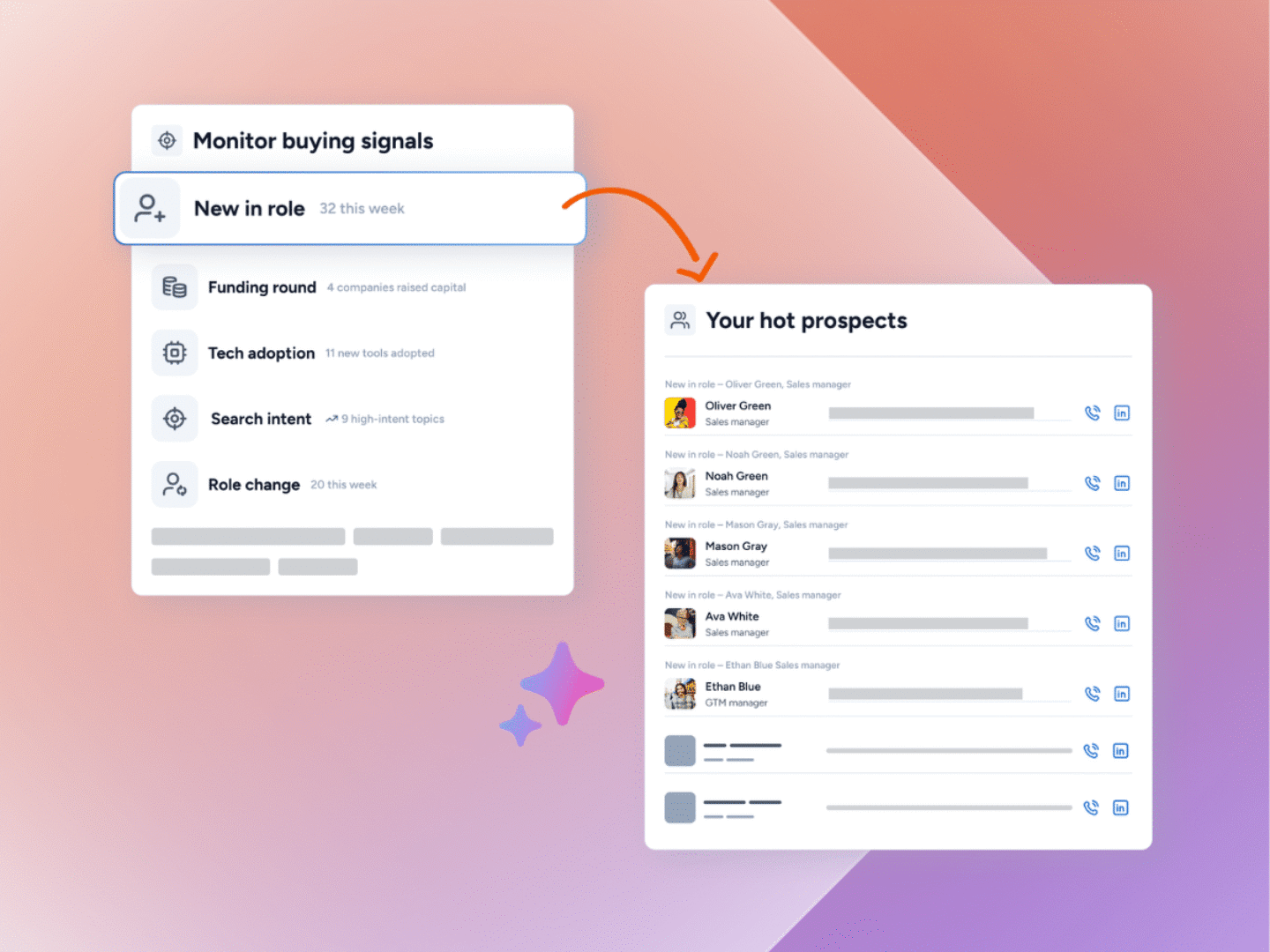
The difference between a list with signals and one without is the difference between cold outreach and warm, timely outreach. Firmable’s AI signal agents continuously monitor your saved lists for these events, surfacing the right accounts at the right moment rather than requiring manual monitoring.
For a full breakdown of signal types and how to act on them, see Firmable’s guide to B2B buying signals.
Step 4: Verify contact data before outreach
Even the best company-level list is only as good as the contact data attached to it. The right company on the list doesn’t help if the decision-maker’s details are wrong.
Key contact data quality checks before outreach:
- Verified mobile numbers – particularly important for outbound calling. Unverified numbers waste call blocks and damage rep morale. Firmable verifies real local mobile numbers – not global head office numbers or stale redirects.
- Direct email addresses – not catch-all addresses or info@ aliases, but verified direct emails for the specific contact.
- Role confirmation – is this person still in the role? Has a better-fit contact joined the team since the record was last updated?
- DNC and regulatory compliance – for Australian outreach, every contact should be checked against the Do Not Call Register before dialing. But DNC is only one layer. Outbound to Australian contacts also falls under the Privacy Act 1988 (specifically Australian Privacy Principle 7, which governs direct marketing) and the Spam Act 2003 (regulated by ACMA, which requires consent and a working unsubscribe on commercial electronic messages). Firmable includes real-time DNC status on every Australian contact and surfaces the data lineage needed to meet privacy obligations under APP 7.
Step 5: Keep your list fresh – lists aren’t static
A prospect list is a living document, not a one-time export. Without active maintenance, quality degrades continuously.
Best practices for list maintenance:
- Review and re-verify at least quarterly Remove contacts who’ve bounced, changed companies, or opted out. Add new contacts at accounts where your original contact has moved on.
- Use enrichment to fill gaps When contacts are incomplete – missing a mobile number, outdated job title, missing technographic data – enrichment fills those gaps automatically. Firmable’s guide to data cleansing and enrichment covers how to run this as a continuous process rather than a one-off exercise.
- Sync to your CRM Manual exports create immediate data lag. A platform that pushes updates directly into your CRM ensures your list reflects the real state of your market, not a snapshot from three months ago.
- Monitor for trigger events/ buying signals Accounts move in and out of buying readiness. A company that was cold six months ago may have just raised a Series B. Signal agents that monitor your lists continuously mean you capture these moments automatically.
Frequently asked questions about B2B prospect list building
An ICP-matched prospect list is a curated set of companies and contacts that have been filtered against your Ideal Customer Profile – the defined attributes of accounts most likely to buy, convert efficiently, and deliver strong lifetime value. Unlike a generic contact export, an ICP-matched list applies multiple layers of filtering – firmographic, technographic, and signal-based – to ensure every account on the list represents a genuine opportunity.
At minimum, quarterly. B2B contact data decays continuously as people change roles, companies restructure, and email domains move – and Salesforce’s State of Sales research found that only about a third of sales pros trust their organization’s data accuracy at any given moment. For active outbound campaigns, continuous enrichment through a platform that monitors and updates records in real time is significantly more effective than periodic manual refreshes.
The most effective lists combine firmographic data (industry, size, revenue, location), technographic data (technology stack, tools in use), growth signals (hiring activity, funding events), and verified contact data (direct mobile, email). Local employee count – not just global headcount – is a critical but often overlooked firmographic filter, particularly for APAC teams targeting companies with verified in-market presence. Company register data adds another powerful layer, giving access to pre-defined, verified segments like industry association members or licensed operators that generic database searches can’t surface. For APAC markets, additional attributes like ABN/NZBN, DNC status, and local register data add significant targeting precision.
A prospect list targets companies and contacts that match your ICP but haven’t yet engaged with your business. A lead list includes people who’ve already shown some form of interest. Prospects require initial outreach to generate interest; leads are further along the funnel and require nurturing and qualification toward a decision.
Buying signals layer timing intelligence on top of a firmographic list. Rather than reaching out to every ICP-fit account at equal priority, signals identify which accounts are showing active in-market behavior right now – a funding event, a new hire, a technology change. Gartner finds the typical B2B buying group involves six to ten decision-makers, each doing four to five pieces of independent research – signals help you reach those groups while they’re already in motion, instead of cold. This dramatically improves reply rates and conversion because outreach arrives at a relevant moment rather than an arbitrary one.
The non-negotiables are data freshness and verification methodology, depth of coverage in your specific target market, AI-powered ICP search capability, buying signal integration, seamless CRM sync, and compliance with local data privacy requirements. For APAC teams, local market depth – including ABN/NZBN data, verified mobile numbers, and real-time DNC compliance aligned with the Privacy Act 1988 and Spam Act 2003 – is essential. For North American teams, look for vertical-specific data depth beyond standard firmographics.
The bottom line
Volume is the easy part. Any platform can give you thousands of names. The real work is making sure each name on the list is the right company, the right contact, with the right context, at the right moment. That is what separates lists that build pipeline from lists that build activity metrics.
Ready to build prospect lists that convert?
Firmable’s AI-driven platform lets you define your ICP in plain English, generate verified, signal-enriched prospect lists in seconds, and monitor target accounts for the exact moment to reach out. See how Firmable builds prospect lists or start your free trial today.