 Apple Podcasts
 Spotify
 YouTube
About this episode
What does it really take to build and lead high-performing sales teams across multiple markets?
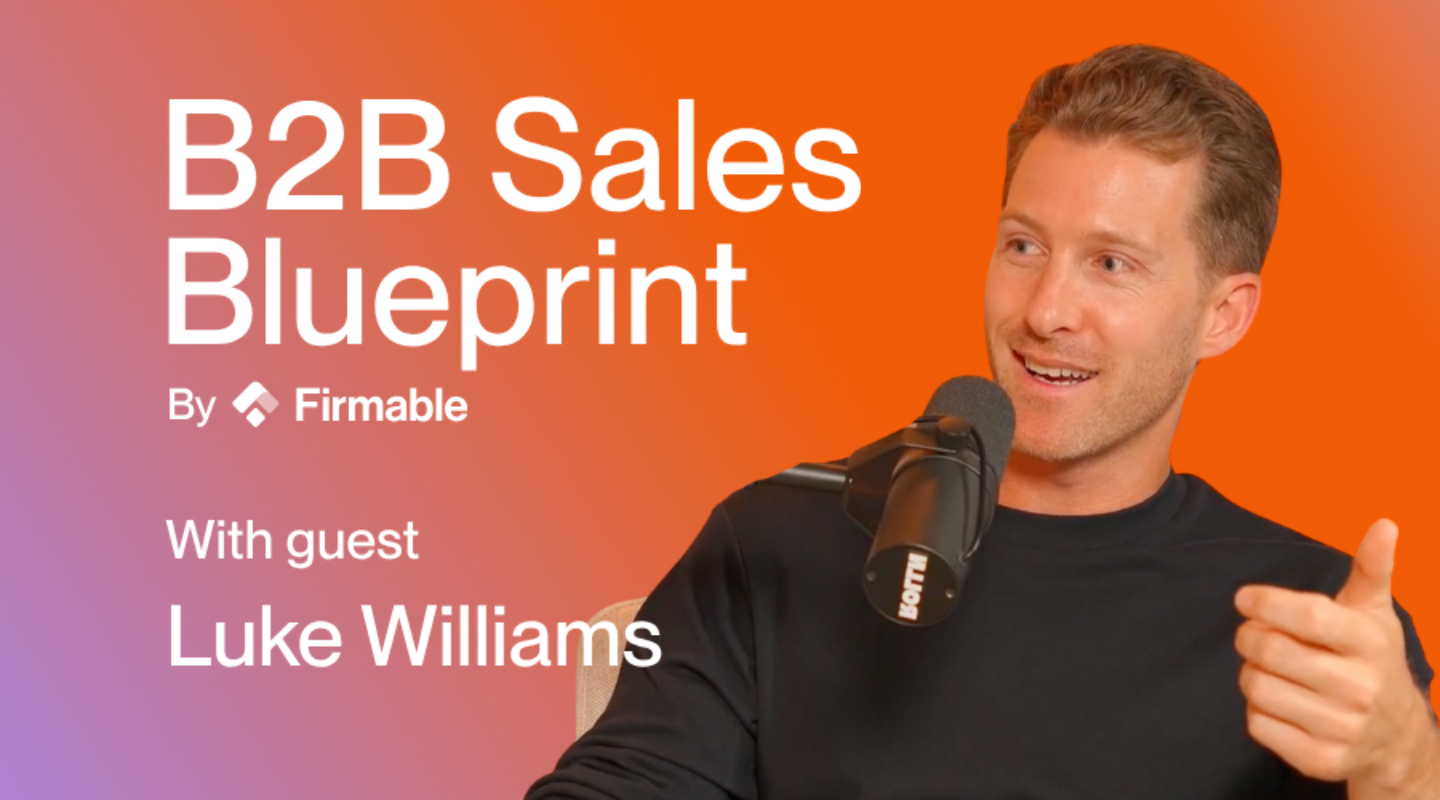
In this episode of B2B Sales Blueprint, Firmable’s Paul Perrett sits down with Luke Williams, VP Americas & APAC at Evotix, to unpack what actually changes as sales teams move upmarket.
Luke has built and led revenue teams across SMB, mid-market, and enterprise segments, scaling go-to-market functions across APAC and the US. In this conversation, he shares practical lessons on how sales methodologies evolve, how leaders should think about deal inspection and coaching, and what it takes to build repeatable sales systems as complexity increases.
From early-stage outbound in low-data environments to rearchitecting enterprise go-to-market strategies, this episode is grounded in real-world experience. It’s designed for teams actively building and scaling pipeline.
What we cover in this episode
- (02:10) Luke’s journey into sales – from door-to-door selling to leading global revenue teams
- (05:30) Building outbound in low-data environments and early lessons from SMB sales
- (09:45) Scaling HazardCo – from service business to SaaS, and finding product-market fit
- (13:20) The inflection point: ecosystem partnerships and unlocking distribution
- (18:10) Moving upmarket – what changes from SMB to enterprise sales
- (21:40) Why sales motion matters more than deal size when defining segments
- (25:15) Rebuilding go-to-market at Evotix – from no pipeline to structured growth
- (29:00) Events, outbound, and ecosystem activation – what actually works
- (33:10) How to build and scale an SDR function (and what most teams get wrong)
- (36:20) Sales methodologies explained: Challenger, SPICED, and MEDDICC in practice
- (40:30) Deal inspection, coaching, and improving forecast accuracy
- (43:00) How AI is changing sales productivity and raising the bar for top performers
Three things that stuck with us about high-performing sales teams
1. What got you to $10K deals won’t get you to $250K
As teams move upmarket, the sales motion fundamentally changes. What works in high-velocity SMB sales – speed, simplicity, and instinct – breaks down in more complex enterprise deals.
Larger deals require more structure, deeper product knowledge, and tighter deal management. The shift is not just about deal size, but about how decisions are made and how sales teams operate.
2. Sales methodologies only matter if you operationalize them
Frameworks like Challenger, SPICED, and MEDDICC are only valuable if they are embedded into how teams actually sell.
The real impact comes from applying them consistently through deal inspection, coaching, and qualification. Without that, they remain theory rather than tools that improve pipeline quality and forecast accuracy.
3. AI will amplify the gap between average and top performers
AI is not replacing salespeople, but it is changing how they work.
By automating research, surfacing insights, and improving coaching, AI allows top performers to operate at a much higher level. The result is a widening gap between those who adopt and those who do not.
About Luke Williams
Luke Williams is Vice President, Americas & APAC at Evotix. He has built and scaled sales teams across Australia, Southeast Asia, and the United States, with experience spanning SMB, mid-market, and enterprise sales.
Luke specializes in building repeatable sales systems, developing high-performing teams, and adapting go-to-market strategies across different markets and levels of complexity.
About Paul Perrett
Paul Perrett is Co-Founder and Co-CEO of Firmable, an AI-powered sales intelligence platform built for APAC.
He has spent his career building and scaling B2B technology businesses, with a focus on sales, go-to-market strategy, and data-driven growth. Through B2B Sales Blueprint, Paul shares practical lessons from operators and leaders building modern revenue teams.
Frequently asked questions about high-performing sales teams
Moving from SMB to enterprise sales is not just about larger deal sizes — it is a shift in sales motion. Enterprise sales involve more stakeholders, longer sales cycles, deeper product understanding, and more structured deal management. High-performing teams introduce stronger qualification, clearer processes, and more rigorous deal inspection as they move upmarket.
→ Related: What is an ideal customer profile (ICP)?
This episode covers Challenger, SPICED, and MEDDICC. Each framework plays a different role depending on the stage of growth. Challenger helps create demand, SPICED supports high-velocity sales, and MEDDICC is used to manage complex enterprise deals. The key is not just adopting a methodology, but applying it consistently across the team.
→ Related: Maximizing cold call effectiveness: Key metrics for SDR success
AI is improving sales productivity by automating research, summarizing calls, and surfacing insights. This allows sales reps to focus more on conversations, strategy, and closing deals. The biggest impact is that AI is raising the performance ceiling — top-performing reps are becoming significantly more effective, while those who do not adopt it risk falling behind.
→ Related: How AI is transforming B2B prospecting
The most important lesson is focus. Companies should narrow their ideal customer profile, prioritize specific industries or segments, and avoid trying to target too broadly. Success in the US requires strong data, clear positioning, and disciplined execution — not just more activity.
→ Related: How to run B2B outbound in Southeast Asia
MEDDICC is a sales qualification framework used in complex B2B sales. It stands for Metrics, Economic Buyer, Decision Criteria, Decision Process, Identify Pain, Champion, and Competition. It helps sales teams qualify deals more effectively, improve forecast accuracy, and prioritize opportunities that are more likely to close
A sales methodology defines how you sell — including how you run discovery, position value, and guide conversations. A qualification framework, such as MEDDICC or SPICED, helps you evaluate deal quality and progression. High-performing sales teams use both together to improve consistency, coaching, and results.