
 Apple Podcasts
 Spotify
 YouTube
About this episode
Most sales teams still try to scale pipeline the old way: hire more reps, add more tools, push for more activity, and hope the numbers move. Rakesh Patni thinks that playbook is being rewritten and that the priority should be to fix your GTM.
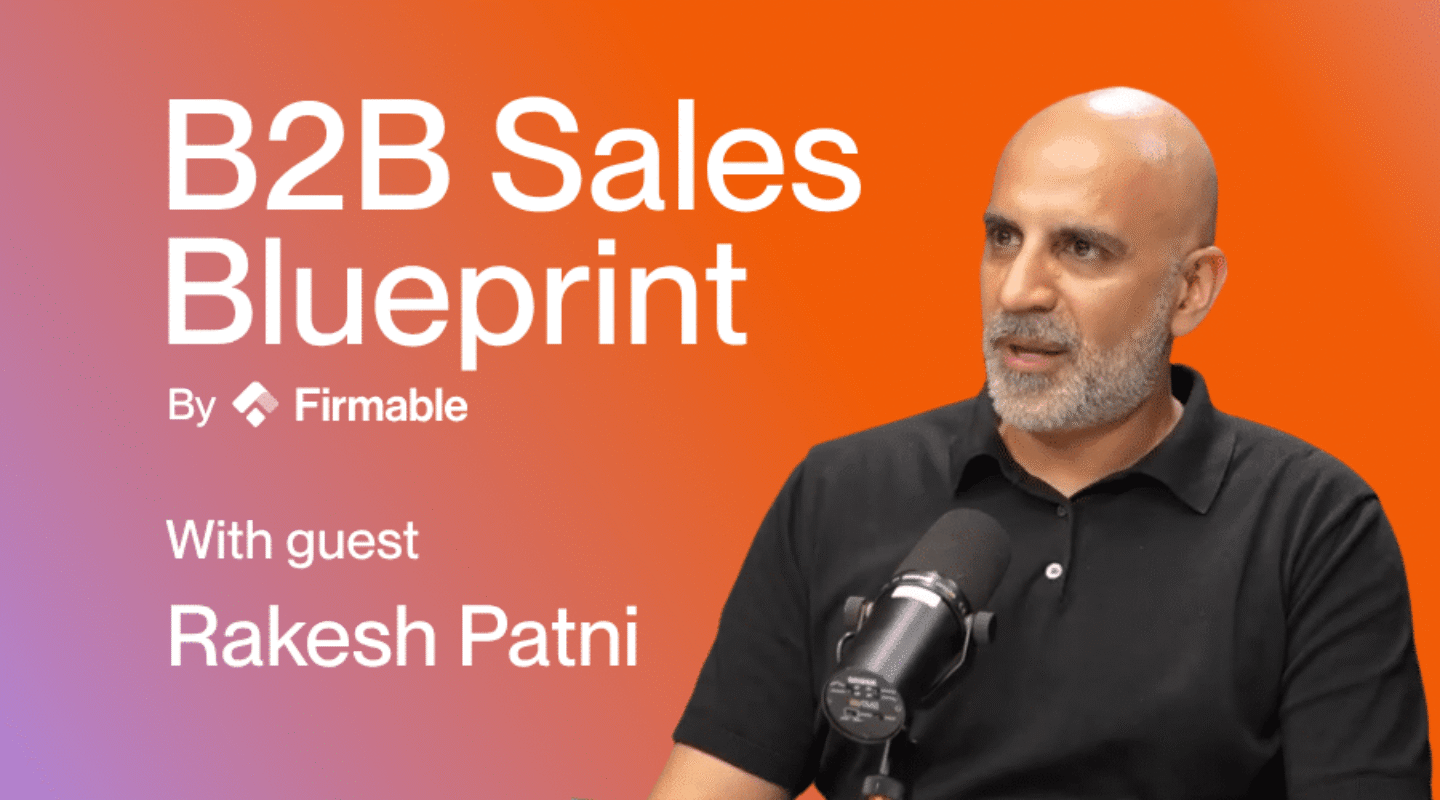
Rakesh is a three-time founder, AI and go-to-market advisor, and former Director at IDC, where he led AI and automation research across Asia-Pacific and Japan. He has built businesses from scratch, exited companies, advised global technology leaders, and spent years helping organizations understand how AI changes the way work gets done.
In this conversation with Paul Perrett, Rakesh unpacks why the next era of B2B sales will be built around systems, signals, data quality, automation, and AI agents working alongside human teams.
He explains why go-to-market is becoming something you design like a product, why buying signals matter more than static lead lists, and why the CRO of the future won’t just manage SDRs and AEs, but a hybrid human and AI workforce.
This is not another abstract conversation about AI. It is a practical look at how sales work is changing, what leaders need to rethink, how to fix your GTM, and why the teams that move faster will build a real competitive advantage.
Key topics covered
- [03:47] How Rakesh was drawn into entrepreneurship through a family business legacy
- [05:17] Starting his first business at 21 and learning sales through trading, trust, and relationships
- [09:30] Building Augmented, a B2B SaaS startup focused on digitising frontline workflows
- [12:00] Why sales is a series of discrete tasks, and how AI starts to reshape those workflows
- [13:40] How Rakesh moved into IDC and began advising global technology companies on AI and go-to-market strategy
- [22:00] How AI agents can turn signals into personalised outreach and CRM tasks
- [22:45] Why go-to-market is increasingly a system you build, not just a team you manage
- [23:20] Why your revenue team needs people who can design the plumbing that will fix your GTM
- [36:45] Where to start when you set out to fix your GTM stack
- [38:45] Why integrations between Firmable, Clay, CRMs, Gong, and other systems make this era different
- [39:35] What makes a great CRO when AI changes the operating model
- [43:00] Will AI reduce sales headcount, or simply increase productivity?
Notable quotes on AI, sales, and how to fix your GTM
“It’s not enough knowing about the lead itself. There’s also a trigger that should come into play.”
“Go-to-market is increasingly a system that you build and architect. It’s like a product.”
“The CRO’s role will not only be managing SDRs and AEs. They’ll have a responsibility to integrate a digital workforce.”
“The first thing I look for is attitude. The second thing I look for is a love for learning.”
FAQs about AI and go-to-market
AI is changing go-to-market by shifting sales teams away from manual, disconnected work and toward systems that can identify accounts, enrich data, surface buying signals, recommend actions, personalize outreach, and push tasks into a CRM.
Rakesh argues that the biggest opportunity is not simply using AI to write emails or summarize calls. It is redesigning the way go-to-market work happens end to end, so teams can make faster, better decisions across prospecting, prioritization, engagement, coaching, and deal management.
Buying signals help sales teams understand not just who fits their ICP, but who is more likely to be ready to buy now.
A company hiring SDRs, changing leadership, expanding into new markets, adopting new technology, or showing intent around a relevant topic may be more worth prioritizing than another account that only looks good on paper. Rakesh describes signals as a critical layer in the go-to-market system because they help teams move from static lead lists to timely, contextual outreach.
GTM engineering is the emerging function responsible for designing and connecting the systems behind revenue growth. A GTM engineer looks at the workflows across data, enrichment, signals, CRM, outbound, automation, and analytics, then builds the plumbing that helps those systems work together.
In Rakesh Patni’s view, this role becomes increasingly important as AI agents and automation become more central to sales. The goal is not just to run campaigns faster, but to build a go-to-market engine where data moves cleanly, tasks are triggered intelligently, and reps can act with better context.
Rakesh recommends starting with clear, discrete tasks. For example, an AI agent might identify high-priority accounts, check for relevant buying signals, enrich the account context, recommend the next action, and create a task in the CRM for the right person.
He warns against using AI to dump large volumes of unqualified accounts into the CRM. Without qualification and clear workflow design, AI can create more mess than momentum. The best use cases are specific, controlled, and tied to a business outcome.
Rakesh’s view is nuanced. In the near term, AI will mostly improve productivity and give salespeople more leverage. It will help reps research faster, personalize better, summarize conversations, identify insights, and prioritize accounts.
Over the longer term, he expects some compression in headcount as companies adopt more advanced AI agents and orchestration layers. But he also makes clear that sales remains deeply human. The role of the salesperson will change, and the people who adapt fastest will have the advantage.
Rakesh believes attitude, adaptability, coachability, and a love of learning matter more than ever. As AI changes how sales work gets done, the best reps will be the ones who are curious enough to experiment, open enough to change their process, and disciplined enough to use technology as leverage. Legacy experience matters less if it means a person is fixed in old ways of working.
Who this is for
This episode is for founders, CROs, sales and RevOps leaders, SDR managers, and anyone trying to understand how AI will change B2B sales.
If you are wondering whether to hire more reps or fix the system around them, this conversation will help. If you are trying to understand buying signals, AI agents, GTM engineering, or the future role of the CRO, Rakesh gives you a practical way to think about what is changing and where to start.
It is especially useful for leaders who know AI matters, but do not want to get lost in hype. The episode connects AI transformation back to the fundamentals that still matter: data quality, process design, customer context, and human judgement.
Subscribe to the B2B Sales Blueprint wherever you get your podcasts for conversations with sales operators, founders, and revenue leaders.
Explore Firmable to build accurate prospect lists, monitor buying signals, and give your sales team the data foundation they need to move faster.