
Sales leaders are tired of being told AI in B2B sales will change everything. They want to know what actually moved a number. What got implemented, what got ripped out, and where money got burned.
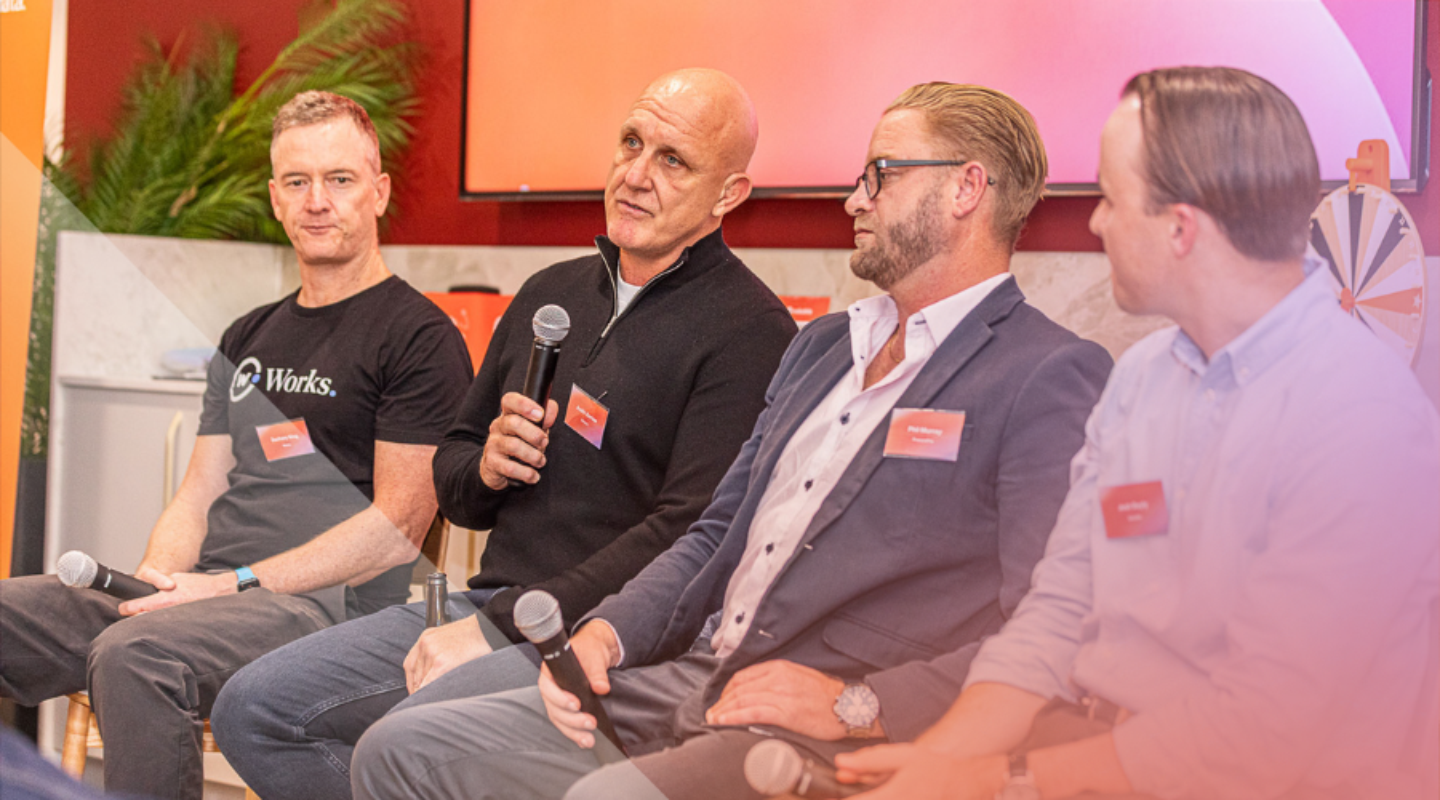
That’s what I set out to uncover at a Brisbane networking event this week, bringing together a panel of sales leaders who are actively building and testing AI inside their teams.
The panel featured Phil Murray, Head of Sales at ProcurePro; Joshua Bayly, Head of Revenue at Askable; Justin Barlow, VP of ANZ Sales at Simpro; and Zachary King, Co-Founder and CEO at Works. Between them, they covered companies ranging from early-stage startups to businesses doing hundreds of millions in ARR – and they weren’t shy about what hasn’t worked.
Here’s what came out of the room.
1. Call intelligence is the high-ROI AI investment most teams haven’t done right
Every panelist had a version of the same story: the moment they connected call recordings to a structured coaching workflow, things changed.
One panelist described building an AI-powered sales coaching loop using call transcripts. Every recorded call gets pushed through an LLM with a sales coaching framework baked into the prompt – MEDDIC, SPIN, whatever the team uses – and the output lands in a Slack channel so the whole team can learn from it in near real time. The result is a learning environment where reps improve from calls they weren’t even on.
Another panelist went deeper into the numbers. Their team ran 120 quarterly business reviews through an AI workflow that pulls data from their CRM, formats it against a brand template, and auto-builds the presentation. Time saved per QBR: seven hours. Across a quarter, that’s 840 hours – close to one FTE’s worth of time returned to higher-value work.
But the standout stat came from a panelist whose team had been using AI-assisted demo prep and post-call scoring to lift conversion. Their UK team was converting at 11% and they wanted to hit 20%. Australia was at 25% and they wanted 30%. The result over the last 180 days: 47.6% conversion.
That’s not a small improvement. That’s a fundamentally different business outcome.
The approach: before each demo, the rep is briefed using AI-scraped context from the CRM, previous engagement history, company data (from the Firmable platform), and even the rep’s own notes. The prospect gets a conversation where the salesperson already knows their world. After the call, a scoring tool built on the team’s own discovery framework gives the rep a structured debrief – no manager required to sit through every recording. Find out how ProcurePro built a repeatable revenue engine by using Firmable.
The takeaway: Call intelligence isn’t just about transcripts. It’s about connecting the insight from those transcripts back into rep behavior, reliably and at scale. Teams that have built that loop are seeing outcomes that teams stuck on basic tooling can’t replicate.
2. AI SDRs mostly got ripped out – and no-one was surprised
One of the sharper moments in the evening came when the conversation turned to what hasn’t worked. I noted that industry data shows somewhere between 50 and 70% of AI SDR and automation tools get pulled within the first year. I asked the panel to respond honestly.
And the response was unanimous. Most of the AI SDR tools they’d tried had been turned off.
One put it directly: LinkedIn has become less a social network and more a B2B marketing platform, and people know it. Automated outreach – even when it’s personalized by AI – is getting spotted immediately. The name might be Alice or Alex but the message reads like a robot wrote it, and the prospect knows.
The deeper issue, as one person described it: AI SDR tools need constant management if they are ever to help SDRs perform. You have to check the inputs every day, review the outputs, adjust the targeting, and iterate on the messaging. That’s not a plug-and-play system. That’s a job. Most teams buy these tools hoping for an autonomous prospecting machine and end up with something that demands more attention than a junior hire – without the ability to adapt in real time the way a human can.
One panelist ran an honest experiment over an extended period, testing every available AI SDR tool under $50,000 per year on behalf of a community of fractional executives trying to generate pipeline. The conclusion: there is no tool you can just connect to your CRM and LinkedIn and watch it work. You can get results, but the effort required to get there defeats the point for most teams.
The panel also flagged a subtler risk: over-automation makes reps lazy. When the AI is doing the prospecting, the research, the sequencing, and the follow-up, salespeople stop understanding the process they’re supposed to be running. One panelist gave a pointed example – asking a rep mid-forecast to explain the key factors in a deal, only to find the rep couldn’t answer because the CRM data had been auto-populated by the tool. The rep had stopped thinking.
The takeaway: AI SDRs are not yet at a point where you can hand them a list and walk away. If you’re considering one, budget time for ongoing management, not just setup. And make sure your reps still understand what the tool is doing on their behalf.
3. The quality of your AI output is the quality of your context
This came up repeatedly, from every panelist, across multiple use cases: AI is only as good as what you feed it.
One team had built an internal knowledge base – a tool trained on years of accumulated sales documentation, objection handling, product notes, customer data, and competitor intelligence. Any rep on any call can ask it a question and get a real answer drawn from actual company knowledge, not a generic response. The moderator compared it to having a brilliant colleague available at all times – one that knows every deal the company has ever run.
But the key word in that description is “documentation.” The system only works because the team had been documenting things obsessively from the start. Every objection, every product update, every competitive insight – it all went in. Teams that haven’t done that can’t build this, at least not quickly.
Another panelist described how context also changes the quality of outbound. Their approach to email sequencing follows a framework where the first line is fully human-researched and genuinely personal – referencing something specific to the prospect, something that couldn’t be auto-generated. That one sentence does the heavy lifting. The rest can be templated. The result: cold outreach response rates of 20 to 40% for the right campaigns, compared to the near-zero rates that AI-only outreach tends to generate now.
The implication for teams earlier in their AI journey: before you add another tool, clean up your data. Audit your CRM. Document your objection handling. Build your ICP definition into a format the AI can actually use. The teams getting the best results aren’t necessarily using more sophisticated tools – they’re feeding better inputs.
The takeaway: Garbage in, garbage out, And that’s more true of AI in B2B sales than it’s ever been of any other technology. The investment in getting your context right pays dividends across every AI use case.
4. Human oversight isn’t a weakness in your AI strategy. It’s the strategy
There was a thread running through the whole evening about the relationship between AI and human judgment, and it surfaced most clearly in a conversation about coaching culture.
One panelist described building a high-performance sales culture around trust and feedback, and making AI a tool that enhances that culture rather than replacing the human elements that make it work. Their team does a “hot seat” exercise where a rep is put in front of the group and hit with questions from all angles. That only works if there’s genuine trust in the room. AI-generated feedback lands differently when it comes from a team that has already built that trust. It becomes useful data rather than a judgment.
The same speaker noted something important about the mechanics of AI feedback: it removes the personal politics. When a transcript analysis says a rep talked over the prospect three times in a 30-minute call, nobody can dismiss it as a manager’s bias. It’s binary. It’s just what happened. That neutrality makes the feedback easier to receive and act on.
But the balance matters. Another panelist was direct about the risk of going too far: if you automate enough of the sales process, you end up with reps who don’t understand what they’re doing or why. They can execute a sequence but can’t explain the deal. They can run a demo but haven’t done the thinking behind it. When the process breaks down – and it will – they don’t have the judgment to adapt.
One team had learned this the hard way with a meeting-booking automation tool. It was working technically, booking meetings, confirming attendance, doing the qualification. But when the team looked at what the AI was actually saying to prospects, the messages read like a checklist being run through. Prospects were arriving at meetings confused about what they were there for. The tool got switched off that week.
The takeaway: AI amplifies what’s already in the room. Got strong culture, strong processes, strong data? AI makes all of those better. Weak foundations just get exposed faster.
5. The companies winning with AI in B2B sales have made it an organizational habit
This might be the insight that separates the teams who are genuinely ahead from the ones still experimenting.
One panelist described a weekly cadence: every department nominates an AI champion, and every week those champions get time together to share what they’ve built, what’s working, and what hasn’t. Small wins get shared. Things that look small often turn out to be useful across multiple teams. The knowledge compounds. And critically, people who might have felt intimidated by AI adoption get permission to try things without the fear of doing it wrong. This has become a big part of our work culture at Firmable this year, too.
Another panelist noted that adoption didn’t really accelerate until they made AI training a formal part of onboarding – not a license and a good luck, but structured instruction with clear guidelines on what could and couldn’t be connected to company systems. Once people felt safe to experiment, usage changed.
The panel also touched on something bigger: institutional knowledge as a competitive asset. Private equity investors, one panelist observed, are starting to look at how companies are documenting and systematizing their processes – not just the financial metrics. A company that has captured its sales methodology, its objection handling, its ICP evolution, and its coaching frameworks in a structured, AI-accessible format is worth more than one that hasn’t. That knowledge doesn’t walk out the door when a senior rep leaves.
The takeaway: The teams pulling ahead aren’t just using AI tools. They’re building AI habits: regular learning sessions, clear ownership, formal onboarding, and consistent documentation. If AI in B2B sales is only one person’s job, it will only ever be one person’s advantage.
Frequently Asked Questions about AI in B2B sales
Based on this panel discussion, the most widely adopted tools across ANZ sales teams include call intelligence platforms (Gong was mentioned, though several teams noted alternatives were emerging as AI capabilities became more accessible), CRM integrations for demo prep, custom GPT-style tools built on internal documentation, and LinkedIn automation for top-of-funnel activity. AI SDR platforms had a much lower retention rate – most panelists had tested and removed at least one.
Not yet, based on what this panel reported. The consensus was that AI SDR tools require significant ongoing management to deliver results, and that fully automated outbound consistently underperforms human-led prospecting in quality of engagement. The phone remains the highest-converting outbound channel in the market. AI is most effective as a support layer for human SDRs – better data, faster research, smarter prioritization – rather than as a replacement.
The panel pointed to two recurring errors: buying tools before understanding the process they’re meant to improve, and failing to invest in the data quality that AI needs to work well. A third mistake, raised more than once, is removing humans from the loop too aggressively – leading to reps who can execute automation but can’t think for themselves when something unexpected happens.
The bottom line
The gap between using AI well and just using AI is real, and it’s widening. The teams ahead right now are not necessarily the ones with the biggest budgets or the most sophisticated tools. They’re the ones who got disciplined about data quality, kept humans in the loop, built feedback cultures that made AI coaching land, and made AI adoption an organizational habit rather than a side project.
The tools will keep improving. The teams that build the habits now will have the biggest head start when they do.
Want to see how better data changes what’s possible for your sales team? Firmable gives sales and marketing teams the most accurate and comprehensive B2B data and buying signals available, so your AI tools, your SDRs, and your AEs are all working from the same quality foundation. Explore Firmable.