 Apple Podcasts
 Spotify
 YouTube
About this episode
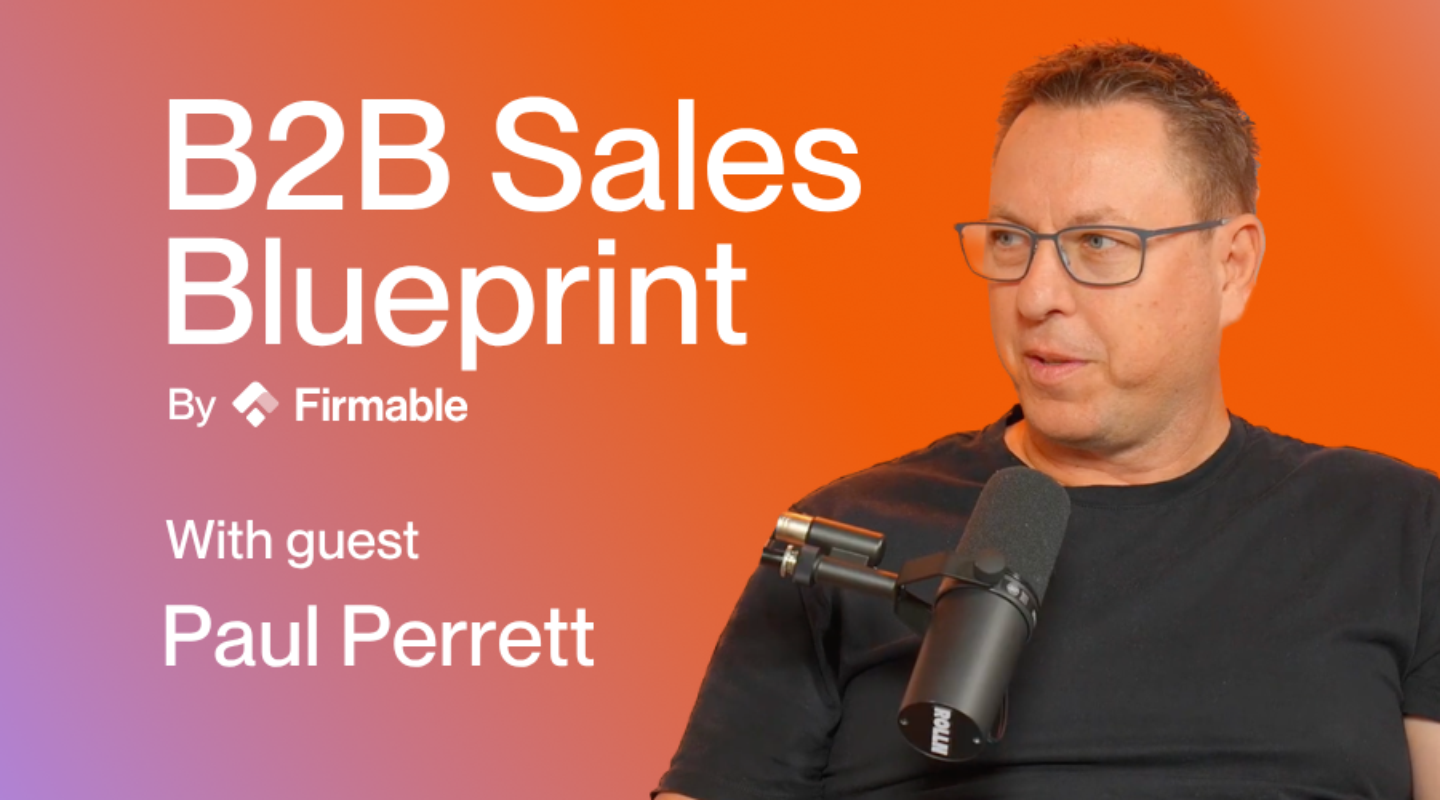
Paul Perrett is one of Australia’s most accomplished B2B go-to-market operators. As COO at Aconex, he helped scale the business from $25M to $250M in revenue before its $1.6B acquisition by Oracle. He then took the CEO role at Message Media and drove a similar revenue journey before its $1.7B exit. He now brings that pattern recognition to Firmable as a key voice in the company’s go-to-market thinking.
This episode covers the full arc: what Paul looks for when evaluating whether a business can become big, how he adapted his approach between the high-touch enterprise sales motion at Aconex and the high-velocity, data-driven SMB model at Message Media, and why the explosion of AI-powered outreach tools has paradoxically made relationships and trust more important than ever.
Paul is direct about what most teams get wrong – treating go-to-market as a sales-and-marketing problem rather than a whole-of-business system – and shares what Firmable has learned building its own GTM engine in APAC. He also gets into attribution, measurement, what it actually means to hire first-principles thinkers, and why 70% of Firmable’s deals are now inbound.
If you want frameworks from someone who has built and scaled the real thing, not slides about it, this is the episode.
Key topics covered
- [01:14] Why Paul started the B2B Sales Blueprint podcast — and what the ANZ go-to-market ecosystem is missing
- [05:13] What Paul looks for in a company: real pain, addressable market, and a scalable GTM system
- [07:01] Why go-to-market is a whole-of-business problem, not just a sales and marketing function
- [08:51] How Aconex built a distributed sales organisation across 40+ countries — and the hard lessons from going international
- [11:51] The contrast between enterprise art and transactional science: Aconex vs Message Media
- [13:49] How Paul used external data to map every construction project on the planet – the origin story behind Firmable
- [17:37] Why AI-powered outbound has collapsed response rates from 5-6% to 0.05% – and what’s replacing it
- [19:41] Ecosystem activation: how Firmable drives 70% inbound through community and trust
- [20:22] The role of the SDR in a noisy market – and when outbound calling still works
- [23:49] How to think about go-to-market measurement without getting lost in attribution debates
Notable quotes about B2B go-to-market
“As things get easier, they get harder. You would send 100 emails and get five, six, seven responses and you’re like, wow, this is amazing. And then, with the rise of AI and more and more sequencing, you’ve seen that 5 or 6% is now 0.5% or 0.05%.”
“I think people are now almost going back old school — I’m going to ask someone what they think. You orientate back to brands, or you ask people. Or you listen to a podcast.”
“The biggest mistake I think people make is don’t think about it holistically. Don’t think about it as sales or marketing. You’ve got to think about the whole.”
“Enterprise selling in a way is a little bit of art. Whereas as you get more transactional, it becomes a bit more science.”
FAQs about B2B go-to-market strategy
Ecosystem activation is the practice of engaging your target community — sales leaders, operators, potential buyers — as participants rather than targets. Instead of broadcasting outreach, you create genuine touchpoints through content, events, podcasts, and referral relationships that make your brand a natural part of the conversation. Paul Perrett attributes 70% of Firmable’s inbound pipeline to this approach.
AI has made it easier to send high-volume, personalised outreach at scale — which has flooded inboxes and collapsed response rates. Where automated email sequences once generated 5-6% response rates, many teams now see 0.05% or less. The practical result is that trust, referral, and brand-led channels have become disproportionately valuable relative to cold outreach volume.
Paul Perrett defines a scalable GTM system as one where you have clarity on your ICP, a repeatable set of inputs you can do consistently and grow, and a whole-of-business culture oriented around growth — not just a sales team with targets. It looks different at every deal size, but the common thread is that it is systematic, measurable, and not dependent on heroics.
Who this is for
This episode is for sales leaders, CROs, and founders at B2B tech companies who are scaling past early traction and trying to build something repeatable. It’s particularly relevant if you’re navigating the tension between outbound efficiency and declining response rates, trying to define your ICP more tightly, or wondering whether your go-to-market motion is as systematic as it needs to be to get to the next stage.